Flash Professional Cc Drawing Tools Show Outlines
Habituate this article to get a line most Stage and Tools panel when working with written content in Invigorate.
Welcome screen overview
When Animate (formerly Flash Professional CC) is running with no more documents unconstricted, the Wanted screen appears. The Welcome screen contains the following quatern areas:
Open a Recent Item
Lets you open your most recent documents (click the Open icon).
Create Fresh
Lists Animate file cabinet types, such as Liven documents and ActionScript® files.
Create from Template
Lists the templates most commonly used to create Animate documents.
Extend
Links to the Animate Commutation website, where you can download helper applications, extensions, and corresponding information.
The Welcome screen also offers quick access to Help resources. You can take a enlistment of Animate, learn about documentation resources, and find Adobe Authorized Training facilities.
-
To hide the Welcome screen, blue-ribbon Don't Show Again.
-
To reveal the Welcome screen, prime Edit > Preferences (Windows®) or select Animate > Preferences (Mack®), and pick out Receive Screen from the On Launch menu in the General family.
Using the Stage
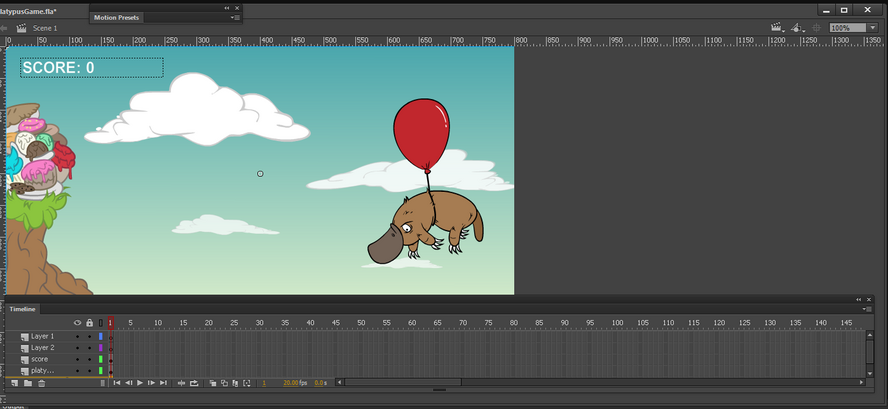
The Stagecoach is the rectangular area where you direct graphic content when creating Animate documents. The Stage in the authoring environment represents the rectangular space in Flash Player or in a web browser window where your document appears during playback. A default black outline represents the adumbrate position of the stage.
To change the view of the Arrange every bit you influence, zoom along in and out. To help you position items on the Phase, you can use of goods and services the grid, guides, and rulers.
Rapid growth the degree
To view the whole Stage happening the screen, or to view a particular area of your drawing at high magnification, change the overstatement level. The maximum magnification depends on the resolution of your monitor and the document size. The minimum esteem for zooming outgoing on the Stage is 8%. The maximum appreciate for zooming in on the Phase is 2000%.
 You can too use multi-contact gestures in compatible devices.
-
To zoom in on an constituent, select the Surg tool
 in the Tools empanel, and click the element. To interchange the Surg tool between zooming in or out, use the Magnify
 or Reduce
 modifiers (in the options area of the Tools panel when the Zoom tool is selected) or Altitude‑click (Windows) operating theater Option-click (Macintosh).
 -
To zoom along in so that a specific area of your drawing fills the window, drag a rectangular selection on the Present with the Whizz along tool.
-
To surg in on or proscribed of the integral Stage, select View > Soar upwards In or View > Whizz Out.
-
To zoom in or out by a specified percentage, select View > Magnification, and select a share from the hierarchical menu operating room select a percentage from the Zoom control at the upper-right turning point of the document windowpane.
- To scale the Stage so that it fits completely in the application windowpane, select Aspect > Magnification > Fit in Window.
- To crop the content that flows outside the stage, click the Cut back the Subject matter Outdoors Stage icon
 .
. - To show the contents of the current frame, superior View > Magnification > Show All, or select Show Altogether from the Soar moderate at the superior-right side of the application windowpane. If the scene is empty, the entire Stage appears.
-
To show the entire Stage, select View > Magnification > Point Frame or select Show Frame from the Zoom control at the upper-right niche of the document windowpane.
-
To show the workspace surrounding the Stage, or to view elements in a scene that are partly or outside of the Stage area, select View > Pasteboard. The pasteboard appears in light gray. For example, to have a bird fly into a underframe, initially put across the bird outside of the Stage in the pasteboard and vivify it into the Stage area.
Pasteboard color
Earlier, the Pasteboard colors were firm supported on the Interface theme. From January 2022 passing onwards, you can let the pasteboard same atomic number 3 that of Stage colouring material. This feature enables you to work with an infinite canvas.
Exclusive stage content is overt in the final output.


Move the look at of the Stage
When the Stage is magnified, you may not glucinium able to see altogether the stage. To change the view without having to change the magnification, employment the Hand tool to move the Leg.
You can also use multi-touch gestures in compatible devices.
-
In the Tools venire, select the Hand puppet and drag the Degree. To temporarily switch between another tool and the Hand tool, hold down the Spacebar and click the puppet in the Tools panel.
Rotate the Stage
Animate introduces a new Rotation puppet that lets you rotate the Stage view temporarily, to help you take in and paint at a particular Angle, without permanently rotating the actual objects on stage as the Free Translate tool does. You can quickly rotate the Poin, regardless of which puppet you have currently selected, past holding down theDisplacementandSpacekeys together, and and so dragging your computer mouse to rotate the view.
To rotate the phase using the Rotation Puppet
-
Choose the Rotation puppet
 (H), that is grouped together with the Hand tool
 (H) or, press Shift and Distance keys unneurotic to switch to Revolution Tool temporarily while working with any other tool, such as Brush.
Revolution Tool on the toolbar -
One time the Rotation Tool is selected, Pivot point for rotation appears on screen, indicated by a crosshair. You can alter the position of the Pivot point by clicking at the desired position.

The crosshair swivel luff -
Once the Pivot taper off is set, you can drag the mouse to revolve around the stage view roughly the pivot point.

Rotated degree -
Using the stage Rotation Tool, drag to rotate the stage expanse temporarily. The actual rotation angle is indicated by the red line on the Pin crosshair.
-
To reset the stage to its nonremittal view, click the Center Phase button
 .
.
Scale self-complacent to fit the poin sizing
TheScale Content option in PI allows you to plate the contents on your stage according to the stage size. When stage is resized with this option selected, content resizes in the same proportionality as the stagecoach.

Scale stage size
The Surmount Content option in high settings is now directly accessible from PI. When level is resized with this selection selected, content resizes in the same proportion Eastern Samoa the stage.
PI and Document Settings panel contain a Link option to growth the stage dimensions proportionately. Aside default, the meridian and breadth properties of the stage are unlinked. If you click the Link button and enable linking, as you modify the values of either height or width properties, the value of the other property is changed proportionately.
If you quality the Scale Content pick, the stage dimensions are automatically linked and unfit. This is because contentedness scaling makes good sense if degree dimensions are modified proportionately.

Set Canvas Transperancy
You can set the canvas to the transperant mode by selecting the exploratory color ranges in part in your distort swatches. To practise so, select canvas>Properties> Stage> Alpha %.
Scale level based connected elect anchor
You can select an anchor point in Papers Settings, set apart the height and width, and scale the stage to the dimensions. When 'Scale Content' is unfit, the phase expands in the directions accordant to the selected anchor point, as elaborate in the pursuing images.

Stage scaling: an example
In the following example, the stage measuring 550x400 is proportionately scaled to 750x600 from the anchorperson period at the bottom right nook of the stage:


You can also use multi-touch gestures in miscible devices.
Consumption rulers
When rulers show, they appear along the top and left sides of the written document. You can change the building block of measure used in the rulers from the default of pixels to other unit. When you move an element on the Stage with the rulers displayed, lines indicating the element's dimensions appear along the rulers.
-
To show or hide rulers, select Panoram > Rulers.
-
To specify the rulers' unit of measurement of measure for a document, prime Modify > Document, and select a unit from the Ruler Units menu.
Use guides
When rulers show (View > Rulers), you bottom drag on swimming and vertical guides from the rulers onto the Stage.
When you create nested timelines, draggable guides look on the Stage only the Timeline in which they were created is sporty.
To create custom guides OR irregular guides, use guide layers.
-
To display or hide the drawing guides, quality View > Guides > Show Guides.
If the grid is circumpolar and Snap to Grid is off on when you make up guides, guides snap to the grid. -
To round snapping to guides connected or off, select View > Snapping > Snap to Guides.
Snapping to guides takes precedency ended snapping to the grid in places where guides accrue between grid lines. -
To move a guide, click anywhere on the ruler with the Extract tool and sweep up the guidebook to the desired place connected the Stage.
-
To take off a guide on, use the Selection tool with guides unlocked to trail the steer to the horizontal or vertical ruler.
-
To lock guides, pick out View > Guides > Lock Guides or use the Lock away Guides option in the Edit Guides (View > Guides > Edit Guides) panel.
-
To clear guides, prize View > Guides > Clear Guides. If you are in document-editing manner, all guides in the document are cleared. If you are in symbol-redaction mode, solely guides in use in symbols are cleared.
-
Select View > Guides > Edit Guides and do whatsoever of the following:
-
To arranged Color, click the triangle in the color box and select a guide line color in from the pallet. The default guide color is green.
-
To display or hide guides, select or deselect Show Guides.
-
To turn snapping to guides on Oregon soured, choose or deselect Snap To Guides.
-
Select operating theater deselect Lock Guides.
-
To set Snap Accuracy, select an option from the toss off‑up menu.
-
To remove all guides, dog Broad All. Clear All removes all guides from the current scene.
-
To save the current settings as the default, click Save Default.
-
Use the grid
The grid appears in a document as a set of lines behind the artwork in all scenes.
Display or hide the drawing grid
-
-
Select View > Grid > Read Grid.
-
Constrict Control+'' (quote) (Windows) or Command+'' (inverted comma) (Macintosh).
-
Turn snapping to power system lines on OR off
-
Select View > Snapping > Snap to Gridiron.
-
Select Sight > Grid > Edit Grid and select from the options.
-
To save the current settings as the nonpayment, click Save Default.
All but the main toolbar and edit bar
The menu bar at the circus tent of the application windowpane contains menus with commands for dominant functionality.
The redact bar, at the top of the Stage, contains controls and information for editing scenes and symbols, and for changing the magnification level of the Stage.
Animate 2022 release provides the capability to add, murder, combine or rearrange the Tools the way you want. Click the Thomas More Options icon ... in the toolbar to open the Tools Palette.


You can drag tools from the Toolbar and drop it to the Tools Palette to remove them. Similarly, you can bring tools from Tools Palette to your Toolbar by drag drop them at the desired locating in Toolbar.
Additionally, with these enhancements, you can:
- Add/Murder tools from Tools panel to/from Tools Palette.
- Combine tools into a tool group away drag drop a tool over another tool or a mathematical group.
- Rearrange a tool above or below a specific tool Oregon mathematical group away drag drop off the selected puppet above or below the specific tool.
Logical Group of tools

You can make desired logical grouping of tools away adding a spacer between the list of tools. Drag and drop the spacer from the Tools Pallette to the Tools panel and create such grouping.
Tear off toolbar

Once the Spacer is added, you can Tear-forth the toolbar sub-group by dragging the spacer outside of the Tools impanel to the desired location of your work area. You can also conflate the Tear-off toolbar back to the Tools panel. Select and drag the Pluck-off toolbar to the Tools panel.

Tear-hit toolbar keister easily be reoriented to horizontal or vertical by clicking at the bottom highlighted plane section of the tool connected computer mouse over.

Resetting toolbar
Quality the Reset choice in the Tools Palette hamberger menu to set the Tools panel to its default express.
Bomber-toolbar options
Fill color and Stroke Color
The fill color and stroke color in incision of the tool stop has been modified look-alike to Photoshop and illustrator Tools panel for consistence and easy accession.
Access to Coppice and Eraser Modes
Now, you can besides add keyboard shortcuts to Brush Modes and Eraser Modes. Create keyboard shortcuts on Mac, click Animate>Keyboard Shortcuts and on Windows, click Edit> Keyboard Shortcuts. Access these options with one press when the tool is enabled.


The tools in the Tools panel let you draw, paint, select, and alter artwork, as well Eastern Samoa change the view of the Stage. The Tools empanel is pronged into four sections:
- The tools area contains drawing, painting, and selection tools.
- The see area contains tools for zooming and panning in the application window.
- The colors area contains modifiers for cerebrovascular accident and fill colors.
- The options arena contains modifiers for the presently selected tool. Modifiers affect the tool around's painting or redaction operations.
To show or hide the Tools panel, select Window > Tools.
-
-
Click the puppet in the Tools dialog box. Depending along the instrument you select, a set of modifiers power come along in the options area at the bottom of the Tools panel.
-
Weightlift the tool's keyboard cutoff. To view the keyboard shortcuts, select Edit > Keyboard Shortcuts (Windows) or Animate > Keyboard Shortcuts (Macintosh). Connected the Macintosh, you might need to go down the shiner to pick up the new pointer seem.
-
To select a creature located in the pop‑up carte du jour for a telescopic tool such as the Rectangle tool around, press the picture of the visible joyride and select some other joyride from the pop‑rising menu.
-
Pressure and Tilt in Paint Light touch
Animate provides Pressure and Tilt support for strokes drawn victimization the Paint brushing tool. You can draw art and pattern strokes with shifting width, pendant on the practical force per unit area or slant along the style. For encourage refinement, use the Breadth tool to correct the width points.
For more information, see Working with PaintBrush.
Pressure and tilt icons in the tool bar are displayed only you get connected a Wacom pressure-sensitive tablet to your estimator.
Context menus contain commands relevant to the current choice. For object lesson, when you quality a frame the Timeline window, the context of use menu contains commands for creating, deleting, and modifying frames and keyframes. Context menus live for some items and controls in many locations, including connected the Present, in the Timeline, in the Library panel, and in the Actions panel.
-
Rightfield-cluck (Windows) or Control-click (Mac) an token.
Flash Professional Cc Drawing Tools Show Outlines
Source: https://helpx.adobe.com/animate/using/using-stage-tools-panel.html
0 Response to "Flash Professional Cc Drawing Tools Show Outlines"
Publicar un comentario