How Much Ssdi Can a Family Receive Per Month?
Social Security's family unit maximum rules limit the total benefits payable to a casher'southward family. Unlike family maximum rules apply to retirement and survivor benefits than to inability benefits. The rules for calculating family maximum benefits are complicated. In some particularly complex cases, it is hard to properly implement the family maximum, which tin result in over- or underpayments. This article explains how the family unit maximum rules piece of work and describes their evolution. We apply Modeling Income in the Well-nigh Term, Version 6 data to clarify who is affected by the family maximum and to what extent their benefits are inverse.
Kathleen Romig is a senior policy annotator at the Eye on Upkeep and Policy Priorities. Dave Shoffner is a social science research analyst with the Office of Retirement Policy, Office of Retirement and Disability Policy, Social Security Administration.
Acknowledgments: The authors thank Joni Lavery, Andrew Hanks, Eric Herbert, Karen Glenn, Mark Sarney, and Natalie Lu for their helpful comments and suggestions.
The findings and conclusions presented in the Message are those of the authors and do not necessarily correspond the views of the Center on Upkeep and Policy Priorities or the Social Security Administration.
Introduction
| AIME | average indexed monthly earnings |
| AWI | boilerplate wage index |
| DI | Disability Insurance |
| MINT | Modeling Income in the Near Term |
| OASI | Old-Age and Survivors Insurance |
| PIA | primary insurance amount |
| SSA | Social Security Administration |
Workers receive Social Security retirement and inability benefits based on their covered earnings. Members of their families may also qualify for benefits based on those earnings—for example, their survivors, spouses, and children. Benefits for family unit members accept ever been limited by the family maximum rules. In 1980, Congress established more than restrictive rules for the families of disabled workers, reflecting concerns that some disability beneficiaries were financially every bit well off, or better off, when receiving benefits than they were when working. The family maximum rules have evolved over fourth dimension and have become more than complicated for all beneficiaries, which in some cases make them hard to implement. If not implemented correctly, the Social Security Administration (SSA) may pay beneficiaries improperly.
In this article, we depict the electric current family maximum rules using illustrations of unlike benefit types. We also depict the rules for beneficiaries entitled to benefits on multiple earnings records. We explain how the family maximum rules have evolved over time then provide an analysis of the rules at dissimilar earnings levels, by comparing those for retirement and survivor families with those for disability families. Using Modeling Income in the Near Term, Version half dozen (MINT6) data, we analyze who is affected by the family maximum and to what extent their benefits are changed.
Major Findings
SSA's family unit maximum rules are complex and affect beneficiaries in different means, depending on their earnings levels and benefit types. In particular, the rules that utilise to inability beneficiary families differ significantly from those that apply to retirement and survivor beneficiary families. Our findings include the following:
- The disabled family unit maximum affects many more families and a wider range of family sizes than the retirement and survivor family maximum because more restrictive rules employ to disability benefits.
- Retirement and survivor beneficiary families are non affected by the family maximum rules unless three or more family members receive benefits; when those casher families are affected, auxiliary beneficiaries (or auxiliaries) ever receive partial benefits.
- Disability beneficiary families, by contrast, sometimes lose all of their auxiliary benefits, even in cases where only 1 family member qualifies. All disability families with three or more beneficiaries are affected by the family maximum and more than half of families with two beneficiaries are affected.
- Amongst families affected by the family maximum, reductions can exist substantial. For affected disabled-worker families, we estimate that the median reduction is virtually 33 percent; for survivor families, nearly 23 per centum; for retired-worker families, about xiv percentage. For some family members of disabled workers, the family maximum rules prevent a benefit from being paid at all.
Current-Police force Family Maximum Rules
In this section, nosotros provide the current basic family maximum rules for retirement and survivor benefits and for disability benefits. We besides discuss current-constabulary rules that are common to both types of benefits.
Rules for Retirement and Survivor Benefits
The family unit maximum formula for Old-Age and Survivors Insurance (OASI) benefits is based on a beneficiary's primary insurance amount (PIA). The PIA is a casher's basic Social Security do good corporeality before adjustments for retirement historic period, earnings, and other factors.1 For a worker who reaches historic period 62 or dies in 2015 (before reaching historic period 62), SSA calculates the family maximum using the following formula:
150 percentage of the first $1,056 of the worker'south PIA plus
272 percent of the worker's PIA over $1,056 through $1,524 plus
134 percent of the worker's PIA over $one,524 through $1,987 plus
175 percent of the worker's PIA over $1,987.
Ultimately, this formula yields a maximum for each family unit that is between 150 percent and 188 percent of the worker's basic Social Security benefit, or PIA.2 The terminal amount is rounded to the side by side lowest ten cents. The dollar amounts in the family maximum formula increase each yr according to average wage growth.3
Rules for Disability Benefits
Disability Insurance (DI) beneficiaries are subject field to a more restrictive set of family maximum rules than are OASI beneficiaries. As with OASI beneficiaries, people who became entitled to disability benefits earlier 1979 are subject field to a different family maximum formula. The family maximum for a disabled worker is 85 pct of the worker's average indexed monthly earnings (AIME), a measure of lifetime earnings.4 However, the family maximum for a disabled worker'southward family cannot be more than 150 percentage or less than 100 percent of his or her PIA. The final amount is rounded to the next lowest 10 cents.
Rules Common to Both OASI and DI
The family maximum rules are applied in the same way for both OASI and DI benefits. First, the family maximum amount is established based on the worker's PIA or AIME. Then, the worker's benefit is subtracted from the total benefit amount payable to the family. Next, the auxiliaries' benefits are reduced proportionately. The worker'due south ain benefit is never reduced; merely the benefits of his or her auxiliaries are reduced. The benefits for divorced spouses (including surviving divorced spouses) are never reduced.
Illustrations of the Family Maximum
The post-obit exhibits show how the family unit maximum rules piece of work, using simplified examples of beneficiary families. Nosotros compare benefit amounts before applying the family unit maximum rules with those later applying those rules. We assume that there are no reductions to full do good amounts,5 and nosotros use the 2015 family maximum and PIA formulas.
Survivors of a deceased worker. Table 1 illustrates a case in which a worker dies and is survived by a working-historic period spouse and 2 children, all of whom qualify for survivor benefits.6 We assume the worker has an AIME of $2,253 and in plow has a PIA of $i,200.seven The rules that utilise to survivor beneficiaries are the aforementioned every bit those that use to families of retired workers.
| Characteristic | Monthly benefit amount ($) | Rule applied |
|---|---|---|
| Earlier family unit maximum | ||
| Survivor benefits | ||
| Spouse | 900 | 75% of the worker'due south PIA |
| Child 1 | 900 | 75% of the worker'southward PIA |
| Kid 2 | 900 | 75% of the worker's PIA |
| Total family benefit | 2,700 | Sum of the survivor benefits |
| After family maximum | ||
| Survivor benefits | ||
| Spouse | 659 | ⅓ of the family maximum amount |
| Child 1 | 659 | ⅓ of the family maximum amount |
| Child 2 | 659 | ⅓ of the family maximum amount |
| Full family unit benefit | 1,976 | Sum of the survivor benefits, capped by the family unit maximum amount |
| SOURCE: Authors' calculations. | ||
| NOTE: Dollar values are rounded to the nearest dollar for presentation purposes, but would actually be rounded downward to the nearest dime. | ||
| AIME = average indexed monthly earnings; OASI = Former-Historic period and Survivors Insurance; PIA = master insurance corporeality. | ||
Family of a disabled worker. Table 2 illustrates a case in which a worker becomes disabled and has a spouse and 2 children who qualify for auxiliary disability benefits. We assume, as nosotros did in Table 1, that the worker has an AIME of $two,253 and a PIA of $one,200.
| Characteristic | Monthly benefit amount ($) | Rule applied |
|---|---|---|
| Earlier family maximum | ||
| Worker'southward benefit | ane,200 | 100% of the worker's PIA |
| Auxiliary benefits | ||
| Spouse | 600 | fifty% of the worker's PIA |
| Kid 1 | 600 | l% of the worker'due south PIA |
| Child 2 | 600 | 50% of the worker's PIA |
| Total family benefit | three,000 | Sum of the worker'due south and auxiliaries' benefits |
| Later family maximum | ||
| Worker's benefit | one,200 | 100% of the worker's PIA |
| Auxiliary benefits | ||
| Spouse | 200 | ⅓ of the family maximum corporeality minus the worker's PIA ($600) |
| Kid ane | 200 | ⅓ of the family maximum amount minus the worker's PIA ($600) |
| Child 2 | 200 | ⅓ of the family maximum corporeality minus the worker's PIA ($600) |
| Total family unit benefit | 1,800 | Sum of the worker's and auxiliaries' benefits, capped by the family maximum corporeality |
| SOURCE: Authors' calculations. | ||
| NOTES: Dollar values are rounded to the nearest dollar for presentation purposes, but would actually be rounded downward to the nearest dime. In this instance, 85 per centum of the worker's AIME is $1,915, which is 160 per centum of his or her PIA, greater than the cap of 150 percent of the PIA that applies to inability beneficiaries. Equally a result, the family maximum for this family is $1,800, or 150 percent of the worker'due south PIA. | ||
| AIME = average indexed monthly earnings; DI = Inability Insurance; PIA = principal insurance amount. | ||
Special cases. Most family maximum cases follow the standard family maximum rules that apply to OASI and DI cases, as shown earlier. There are likewise additional rules that apply for more complicated situations. We briefly depict those rules below and include three detailed illustrations of them in Appendix Tables A-ane through A-three. It is in these complex cases that improper payments are well-nigh common, as indicated in a recent SSA Function of the Inspector General study.viii The incorrect payments by and large occur considering they are calculated manually by SSA employees. The agency uses an automatic organization to check standard family maximum cases; for more than complicated cases—such as dually entitled spouses (for case, individuals receiving both a worker do good and a partial spouse benefit), "child-in-intendance" benefits, or combined family maximum cases—there is no such automatic review.
Dually entitled beneficiaries. These beneficiaries are entitled to worker benefits based on their ain earnings as well as auxiliary benefits based on someone else's earnings.9 In dual entitlement cases where the auxiliary do good is higher than the worker benefit, the dually entitled beneficiary receives his or her full worker do good in improver to a partial auxiliary benefit. The total benefit is the same corporeality every bit the full auxiliary benefit. For these dually entitled beneficiaries, the family maximum merely applies to the auxiliary portion of the benefit.
For cases in which a person is eligible for both a worker do good and an auxiliary benefit, the auxiliary do good is reduced or not paid at all. For those beneficiaries, the Parisi case established that any potential but unpaid auxiliary benefits are not included in the family maximum calculation.10 Earlier the Parisi case, a spouse's potential but unpaid spousal benefits would exist included in the family unit maximum and crusade other family members' auxiliary benefits to exist reduced. In the Parisi case, the courts determined that only auxiliary benefits actually paid would count toward the family unit maximum, allowing some beneficiaries to go higher auxiliary benefits than they would have received before the Parisi decision.eleven
Combined family maximum. The combined family unit maximum is used when a person qualifies for auxiliary benefits on more than one worker'south tape. The combined family maximum is the sum of the family unit maximums established for each worker, but it does not exceed the statutory upper limits for combined family maximums. 12 For cases in which a beneficiary qualifies for benefits on multiple records, his or her benefits are determined based on the work record of the worker that volition yield the highest benefit amount.xiii All the same, the family unit maximum is determined based on the sum of the family maximums established for each worker's record.
Legislative History
Congress amended the Social Security Human activity and established the family maximum in 1939, the same year it created auxiliary benefits. These amendments reflected the modify in the emphasis of the original Social Security program, from protecting workers in former historic period to protecting those workers and their family members. Over the years, Congress gradually enacted the following changes:
- The 1939 Amendments set the family unit maximum at the lower of eighty percent of the average monthly wages, $85, or 200 percent of a worker's PIA. The family maximum could non autumn below a flooring of $20.14
- The 1950 Amendments eliminated the 200 percent of the PIA cap and changed the formula to lxxx percent of the worker's boilerplate monthly wages, with a maximum of $150 and a minimum of $40.xv
- The 1954 Amendments stated that the family unit maximum could not exist less than 150 percentage of the PIA.sixteen The 1954 formula remained, with advertising hoc changes to the thresholds, until 1971.17
- The 1971 Amendments established a 2-tier family maximum formula.18 For beneficiaries with PIAs to a higher place $628, the family maximum was 175 percent of the PIA. For those with PIAs below $628, the prior-law formula applied. For all beneficiaries, the family unit maximum could not fall below the floor of 150 percent of the PIA, every bit established in prior law.
- The 1972 Amendments established an automatic cost-of-living adjustment (COLA) for Social Security benefits and a COLA for the family maximum. The COLAsouth were applied in each year after a beneficiary first became entitled, starting in 1975.19
- Legislation in 1972 xx too liberalized the family maximum, requiring its ciphering to be based on the PIA rather than the boilerplate monthly wage.21 This change allowed beneficiaries who became entitled after a benefit increment to get the same benefit amounts as did current beneficiaries.22
Congress established the current-police family maximum rules in the 1977 and 1980 Amendments. Today's OASI beneficiaries are subject to the rules established in 1977 (with wage-indexed adjustments); DI beneficiaries are field of study to the rules established in 1980.
- The 1977 Amendments created a four-tier formula for all beneficiaries: 150 percent of the showtime $236 of the worker's PIA, plus 272 percent of the next $106 of his or her PIA, plus 134 per centum of the next $107 of the PIA, plus 175 percent of the remainder.23 The dollar amounts in the formula increment each yr according to changes in the average wage index (AWI). This formula was designed to replicate the range of family unit maximum amounts established under prior constabulary.
- The 1980 Amendments established a separate family maximum benefit formula for disability beneficiaries at 85 percent of a worker's AIME, with a floor of 100 percent of the worker'due south PIA and a ceiling of 150 pct of the PIA.24 The rule for 85 percent of the AIME was designed so that a family's full benefits could not exceed the worker's average earnings. The cap of 150 pct of the PIA affects college-earning workers; without it, the rule for 85 percent of the AIME would not take affected them.25 The flooring of 100 percent of the PIA ensures that a worker will always get the full benefit to which he or she is entitled, even if none of his or her dependents receives auxiliary benefits. In establishing the more restrictive inability family unit maximum rules in the 1980 Amendments, Congress intended to strengthen piece of work incentives for disabled beneficiaries, reflecting concerns that some of those individuals were financially every bit well off, or improve off, when receiving benefits than when working.26
Analysis of Family Maximum Rules
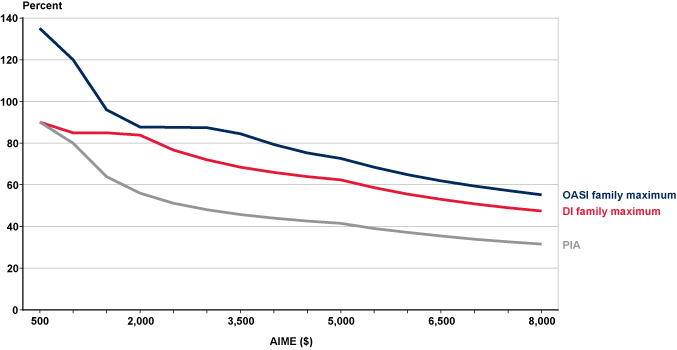
Because of the more restrictive DI family maximum rules, benefits payable to inability beneficiary families are significantly lower than those for retirement and survivor beneficiary families, specially at the lower cease of the earnings calibration. In 2015, newly eligible disabled beneficiaries with AIMEs of $903 or less can accept no auxiliary beneficiaries because the DI family unit maximum for such workers is 100 percent of their PIA. Newly eligible disabled beneficiaries with AIMEsouthward between $904 and $1,942 accept their family benefits reduced, even if they have only ane auxiliary, because the family unit maximum caps their benefits at 85 pct of their AIME (rather than 150 per centum of their PIA, which could allow for one unreduced auxiliary casher).
Chart one shows OASI and DI family maximum amounts as well as the PIA formula (which establishes basic do good amounts) equally percentages of AIME and at each level of AIME—a measure of lifetime earnings. At all earnings levels, the OASI family maximum is more generous than the DI family maximum, replacing a greater proportion of earnings. At the low stop of the earnings scale (specifically, for people whose AIMEdue south are $903 or less in 2015), the DI family maximum is equal to the worker's PIA, which means that no benefits will be paid to disabled-worker family unit members. The DI family maximum is notably less progressive than the OASI family maximum (or PIA), as shown past the slope of each line in Nautical chart 1. The DI family maximum line slopes downward in a relatively straight line, while the OASI family unit maximum is kinked at the depression end because it allows significantly more generous benefits for the families of lower earners.
Chart ane.
OASI and DI family unit maximum amounts and PIA as percentages of AIME, 2015
SOURCE: Authors' calculations.
NOTES: Formulas are based on 2015 rules, which employ to beneficiaries first eligible in 2015.
AIME = average indexed monthly earnings; DI = Disability Insurance; OASI = Old-Age and Survivors Insurance; PIA = main insurance amount.
To provide context, we accept also estimated the distribution of DI and OASI beneficiary families by their AIME levels:27
- Over 400,000 (23 percent) DI beneficiary families with two or more beneficiaries accept AIMEs of less than $1,000. This is approximately the level of lifetime earnings at which disabled workers can have no auxiliary beneficiaries.
- Virtually 600,000 (33 per centum) of such families accept AIMEs between $1,000 and $ii,000. This is approximately the level of lifetime earnings at which disability beneficiary families with two or more members have their benefits reduced by the family maximum rules.
- The remaining approximately 800,000 (44 percent) DI beneficiary families have an AIME of more than $2,000. This is near the level of lifetime earnings at which disability beneficiary families with iii or more than members have their benefits reduced past the family unit maximum rules.
Thus, many DI beneficiaries are subject to the more restrictive family maximum rules that apply at the low end of the earnings calibration, which in many cases mean no or very lilliputian auxiliary benefits are paid. OASI beneficiary families have relatively higher earnings. Still, many of them have AIMEs at the lower end of the earnings scale, where the family maximum rules are relatively more generous for OASI beneficiaries.
Methodology
Our assay is based on information from SSA'southward Almanac Statistical Supplement to the Social Security Bulletin, 2013 and Modeling Income in the Nigh Term, Version 6. MINT6 is a microsimulation project model based on the Demography Agency's Survey of Income and Programme Participation (SIPP). The survey information from SIPP respondents is matched with SSA authoritative records on earnings and benefits through 2009, and so the earnings, benefits, and other life events of those respondents are projected for 2010 and later years. The MINT6 results shown here are projections for 2015.
We reweighted the results for the MINT6 respondents to match the benchmark of the family benefit types shown in the Supplement. This reweighting is necessary because, although the overall population of beneficiary families is similar in the Supplement and MINThalf dozen, some subgroup populations differ noticeably. I limitation of a microsimulation model based on a survey, such as MINT, is the difficulty of precisely estimating the population of a less common subgroup, such as beneficiary families with a larger number of children receiving benefits. Because larger beneficiary families are especially important to the analysis here, reweighting is necessary so that we tin align our data with the benchmark population composition shown in the Supplement's Table 5.H2,28 which is based on all administrative records of beneficiaries in December 2012. Our reweighting method is able to more precisely capture narrower subgroups such as families with more children.
Effects of Family Maximum Rules on Casher Families
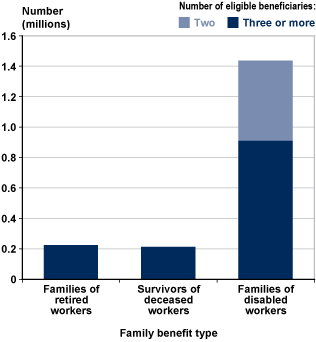
In this section, we clarify the populations of OASI and DI beneficiaries that are affected by the family unit maximum and to what extent their benefits are changed. Nautical chart two shows the estimated number of beneficiary families affected by the family unit maximum rules. This chart distinguishes families by size, separating those with 2 eligible beneficiaries from those with three or more eligible beneficiaries. For some families of disabled workers, a fellow member may exist eligible for auxiliary benefits, but not be paid those benefits considering of the family maximum rules. Families with these potentially eligible beneficiaries are included in the chart.
Chart two.
Number of beneficiary families affected by family maximum rules, by number of eligible beneficiaries in the family, 2015
SOURCE: Authors' estimates using Modeling Income in the Near Term, Version vi.
Notation: Nosotros categorized casher families by size before applying the family unit maximum rules; in some cases, the auxiliary of a disabled worker may be otherwise eligible for a benefit that is not paid considering of the family maximum rules. Such families are included in this chart.
Families of Retired Workers and Survivors of Deceased Workers (OASI)
The family maximum affects all OASI families with three or more beneficiaries, but does not affect families with fewer than iii beneficiaries. We judge that about 200,000 families of retired workers and some other 200,000 survivors of deceased workers take their benefits reduced by the family maximum.
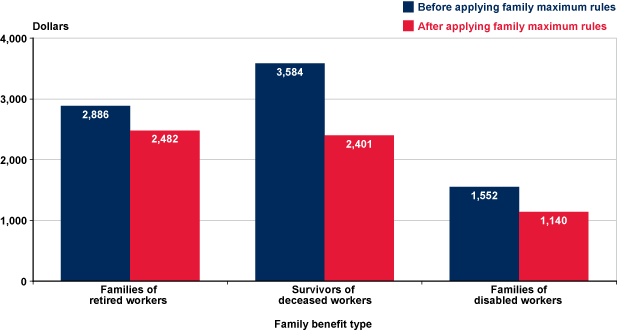
Amidst affected families of retired workers, we estimate that median family benefits are $2,886 before applying the family maximum and $ii,482 later on, equally shown in Nautical chart 3. The median reduction among affected retired-worker families is $535 (14 percent, not shown). All auxiliaries of retired workers receive at least partial benefits.
Among affected survivor beneficiary families, we estimate that median family benefits are $3,584 before applying the family maximum and $two,401 after, as well shown in the chart. The median reduction among afflicted survivor families is $748 (23 pct, not shown). All qualifying survivors receive at least fractional benefits.
Chart 3.
Median family do good amounts before and later on applying the family unit maximum rules among affected families, 2015
SOURCE: Authors' estimates using Modeling Income in the Well-nigh Term, Version 6.
Families of Disabled Workers (DI)
In dissimilarity with OASI beneficiary families, many DI beneficiary families are affected past the family maximum. Near 1.4 1000000 DI beneficiary families are affected, and nearly 400,000 of these disabled casher families have their auxiliary benefits reduced to zip by the family unit maximum rules. In those cases, the family maximum for the disabled worker is 100 percentage of the worker's PIA, which leaves zip for auxiliary beneficiaries.
All families of disabled workers with 3 or more than beneficiaries are affected past the family maximum. In improver, more than half (58 percent) of families of disabled workers with ii beneficiaries (1 worker and one auxiliary) are affected. Taken together, among disabled-worker families with at least i potentially eligible auxiliary, we estimate that nearly fourscore per centum are affected by the family maximum.
Chart iii shows median family benefit amounts before and after applying the family maximum rules. Those values include the effects of benefit reduction factors and delayed retirement credits. They do not account for the furnishings of the windfall elimination provision, the government pension offset, or the retirement earnings exam, which are calculated afterward applying the family maximum rules.
Among affected disability families, we estimate that the median family do good is $1,552 before applying the family maximum and $1,140 after applying the maximum, as shown in the chart. The median reduction for affected disability families is $580 (33 percent, not shown).
The difference in both the percent affected and the median benefits among disabled-worker families shows the bear upon of the stricter disabled family unit maximum rules. The DI family maximum affects many more families and a wider range of family sizes than the OASI family maximum. OASI beneficiary families are not afflicted past the family maximum rules unless three or more family members receive benefits; when those families are affected, members who qualify as auxiliaries always receive partial benefits. DI beneficiary families, by contrast, sometimes lose all of their auxiliary benefits, even in cases where but one family fellow member qualifies.
Conclusion
Equally nosotros take shown in this written report, Social Security'south family maximum rules are complex and affect beneficiaries in different ways, depending on their earnings levels and do good types. In particular, the rules that apply to disability beneficiary families differ significantly from those that apply to retirement and survivor beneficiary families. The disabled family maximum affects many more families and a wider range of family sizes than the retirement and survivor family maximum. All disability families with three or more beneficiaries are affected past the family maximum and more than half of families with two beneficiaries are affected. Families of disabled workers, particularly those with low earnings, sometimes lose all of their auxiliary benefits. For all families affected by the family maximum rules, reductions can exist substantial.
Appendix
The Parisi court decision interpreted the Social Security Act every bit limiting the full benefit amount actually payable on an individual's work record, but not necessarily on the amount of entitlement available in principle. As a result, when determining family maximums, SSA considers only the corporeality of monthly benefits really due or payable to that person.
How the Parisi Case Affects Benefits
Social Security'south dual entitlement rule stipulates that if a person is eligible for both a worker benefit and an auxiliary benefit, the auxiliary do good is reduced or not paid at all. In those cases, the Parisi case established that whatsoever potential but unpaid auxiliary benefit is not included in the family maximum adding. The illustration in Table A-1 shows how the Parisi rules work for a person whose auxiliary benefit is not payable because his or her worker benefit is college. The table uses the same hypothetical disabled-worker casher family equally that illustrated in Table 2, simply assumes that the spouse's worker benefit is $1,000—greater than his or her potential auxiliary benefit of $600.
| Characteristic | Monthly benefit amount ($) | Rule applied |
|---|---|---|
| Earlier family maximum | ||
| Worker's benefit | 1,200 | 100% of the worker's PIA |
| Spouse's worker benefit | 1,000 | 100% of the spouse's PIA; dual entitlement dominion—spouse receives his or her own PIA because the auxiliary benefit is less |
| Auxiliary benefits | ||
| Spouse | 600 | 50% of the worker'southward PIA (potentially), just non actually paid |
| Child ane | 600 | 50% of the worker'southward PIA |
| Kid ii | 600 | 50% of the worker'due south PIA |
| Total family benefit | three,400 | Sum of the worker'southward, spouse'due south, and auxiliaries' benefits |
| After family maximum | ||
| Worker'due south benefit | 1,200 | 100% of the worker's PIA |
| Spouse's worker do good | i,000 | 100% of the spouse's PIA; dual entitlement rule—spouse receives his or her own PIA because the auxiliary do good is less |
| Auxiliary benefits | ||
| Spouse | 600 | Parisi rules: The spouse does not receive an auxiliary do good, so potential auxiliary benefits do not count toward the total family unit maximum auxiliary benefits. |
| Child 1 | 300 | ½ of the family maximum amount minus the worker'southward PIA ($600) |
| Kid 2 | 300 | ½ of the family maximum amount minus the worker's PIA ($600) |
| Total family benefit | 2,800 | Sum of the worker'south and auxiliaries' benefits, capped by the family unit maximum amount, plus the spouse'southward worker benefit |
| SOURCE: Authors' calculations. | ||
| NOTES: Dollar values are rounded to the nearest dollar for presentation purposes, simply would actually be rounded downwards to the nearest dime. In this case, 85 percent of the worker's AIME is $1,915, which is 160 percent of his or her PIA, greater than the cap of 150 percent of the PIA that applies to disability beneficiaries. As a effect, the family maximum for this family is $1,800, or 150 percent of the worker's PIA. | ||
| AIME = average indexed monthly earnings; DI = Disability Insurance; PIA = primary insurance amount. | ||
Dually Entitled Beneficiaries
Table A-ii shows calculations for a disabled-worker family similar to the 1 illustrated in Table A-ane—a disabled worker with a spouse and two children, who has an AIME of $ii,253 and a PIA of $1,200. In this particular showroom, the spouse is dually entitled to a worker benefit of $100 in improver to his or her auxiliary benefit.29 As in Table A-i, the Parisi rules utilise. In this instance, only the auxiliary portion of the spouse'southward benefit would be reduced by the family unit maximum. We assume that the children qualify for auxiliary benefits on the worker's record, but not on the spouse'south.
| Characteristic | Monthly benefit amount ($) | Rule applied |
|---|---|---|
| Before family maximum | ||
| Worker'southward benefit | 1,200 | 100% of the worker'southward PIA |
| Spouse's worker do good | 100 | 100% of the spouse's PIA |
| Auxiliary benefits | ||
| Spouse | 500 | Dual entitlement dominion—50% of the worker'southward PIA ($600) minus the spouse'south PIA ($100) |
| Kid 1 | 600 | 50% of the worker's PIA |
| Child 2 | 600 | 50% of the worker's PIA |
| Full family benefit | three,000 | Sum of the worker's, spouse'southward, and auxiliaries' benefits |
| After family unit maximum | ||
| Worker's benefit | 1,200 | 100% of the worker's PIA |
| Spouse's worker benefit | 100 | 100% of the spouse's PIA |
| Auxiliary benefits | ||
| Spouse | 100 | ⅓ of the family maximum amount minus the worker's PIA ($600) minus the spouse'southward worker PIA |
| Child 1 | 250 | ⅓ of the family maximum corporeality minus the worker's PIA ($600) plus ½ of the $100 withheld from the spouse'south auxiliary benefit |
| Child ii | 250 | ⅓ of the family unit maximum corporeality minus the worker's PIA ($600) plus ½ of the $100 withheld from the spouse's auxiliary benefit |
| Total family do good | 1,900 | Sum of the worker's and auxiliaries' benefits, capped by the family maximum amount, plus the spouse's worker benefit |
| SOURCE: Authors' calculations. | ||
| NOTES: Dollar values are rounded to the nearest dollar for presentation purposes, but would actually exist rounded downwardly to the nearest dime. In this example, 85 percent of the worker'south AIME is $1,915, which is 160 percent of his or her PIA, greater than the cap of 150 per centum of the PIA that applies to disability beneficiaries. As a outcome, the family unit maximum for this family is $1,800, or 150 percent of the worker's PIA. | ||
| AIME = boilerplate indexed monthly earnings; DI = Disability Insurance; PIA = primary insurance amount. | ||
Combined Family Maximum
The combined family maximum is used when a person qualifies for auxiliary benefits on more than one worker's tape. Information technology is the sum of the family maximums applicable to each worker's record, but not more than the statutory upper limits for combined family maximums. xxx
In Table A-3, we presume that two workers die, leaving backside three children who qualify for survivor benefits on both of their parents' piece of work records. Nosotros assume that the mother has a PIA of $1,200 and the male parent has a PIA of $1,000. This illustration shows how benefits are calculated in iii stages: showtime, before applying the family maximum rules; second, using the ordinary family unit maximum rules (in this case, the family maximum that applies to the mother's earnings record—the tape on which the children'due south benefits are based); 3rd, using the combined family unit maximum rules that would decide this family'due south final benefit amounts.
| Characteristic | Monthly benefit amount ($) | Dominion applied |
|---|---|---|
| Earlier family unit maximum | ||
| Survivor benefits | ||
| Child ane | 900 | 75% of the college-earning parent's PIA |
| Child two | 900 | 75% of the higher-earning parent's PIA |
| Kid three | 900 | 75% of the higher-earning parent'due south PIA |
| Total family benefit | ii,700 | Sum of the survivor benefits |
| Later on family unit maximum (higher-earning parent only) | ||
| Survivor benefits | ||
| Child one | 659 | ⅓ of the family maximum amount |
| Child two | 659 | ⅓ of the family maximum amount |
| Child 3 | 659 | ⅓ of the family maximum amount |
| Total family benefit | 1,976 | Family maximum amount |
| Afterward combined family maximum (both parents) | ||
| Survivor benefits | ||
| Child 1 | 900 | 75% of the higher-earning parent's PIA |
| Kid 2 | 900 | 75% of the higher-earning parent's PIA |
| Child 3 | 900 | 75% of the higher-earning parent's PIA |
| Total family unit do good | 2,700 | Sum of the survivor benefits, which is less than the combined family unit maximum |
| SOURCE: Authors' calculations. | ||
| Notation: Dollar values are rounded to the nearest dollar for presentation purposes, but would really be rounded downwardly to the nearest dime. | ||
| AIME = average indexed monthly earnings; OASI = Old-Historic period and Survivors Insurance; PIA = master insurance corporeality. | ||
Notes
1 For more than information most the PIA and how it is calculated, refer to http://www.socialsecurity.gov/oact/cola/piaformula.html.
2 People who became entitled to benefits earlier 1979 are subject to a different family maximum formula (see SSA's Almanac Statistical Supplement to the Social Security Message, 2013 (Table 2.A17), http://world wide web.socialsecurity.gov/policy/docs/statcomps/supplement/2013/2a8-2a19.html#table2.a17.
3 For more information on the boilerplate wage index, which SSA uses to index the family maximum, refer to http://world wide web.socialsecurity.gov/oact/cola/AWI.html.
4 For more information nearly how SSA calculates the AIME, refer to http://www.socialsecurity.gov/oact/cola/Benefits.html.
5 For instance, early retirement reductions, retirement earnings exam withholdings, the windfall elimination provision reductions, and government pension offsets.
vi For more than information about how beneficiaries authorize for survivor benefits, see SSA'south "How Social Security Can Help Y'all When A Family Fellow member Dies," http://www.socialsecurity.gov/pubs/EN-05-10008.pdf.
7 In 2015, the offset bend point would be $826. Thus, the start $826 of the AIME would be multiplied by ninety pct for a value of $743.40. The remaining $ane,427 of the AIME in a higher place the start bend bespeak of $826 would be multiplied by 32 pct for a value of $456.64. Together, $743.40 + 456.64 = $1,200.04. For presentation purposes, the dollar values reported are rounded to the nearest dollar, but the actual PIA rules round down the value to the nearest dime. For additional data on PIA formula bend points and applicable computation methods, refer to http://world wide web.socialsecurity.gov/oact/cola/piaformula.html.
8 Adjustment of Monthly Benefits Nether the Family Maximum Provisions. Inspect Report No.A-09-13-13087 (March 11, 2014), http://oig.ssa.gov/sites/default/files/audit/full/pdf/A-09-13-13087.pdf.
9 The total amount a dually entitled beneficiary receives is equal to the college of the worker do good and the auxiliary do good.
10 These rules are a upshot of the Parisi courtroom decision; for a full description of the ruling, refer to http://www.socialsecurity.gov/OP_Home/rulings/ar/01/AR97-01-ar-01.html. To determine the ruling's applicability in all states, refer to https://secure.ssa.gov/poms.nsf/lnx/0202603045. Examples are given here, https://secure.ssa.gov/poms.nsf/lnx/0300615768.
eleven In the Appendix, meet Tables A-ane and A-2 for illustrations of how the Parisi example affects benefits.
12 For more data, see SSA's Program Operations Manual System RS 00615.770 (simultaneous entitlement of children on more than i worker'south record), https://secure.ssa.gov/apps10/poms.NSF/lnx/0300615770; and RS 00615.772 (determination of the worker tape upon which benefits volition be based), https://secure.ssa.gov/poms.nsf/lnx/0300615772.
xiii The committee written report for the 1972 Amendments states, "The pecker would provide that a child who is entitled to benefits on the earnings record of more than one worker would get benefits based on the earnings tape that results in paying him or her the highest corporeality, if the payment would non reduce the benefits of whatever other individual who is entitled to benefits based on that earnings tape. (Entitlement of a kid on the earnings record that will give him or her the highest benefit could otherwise upshot in a reduction of the benefits for other people entitled on the aforementioned earnings record because of the family maximum limitation.)" (Congressional Record on S. 18480, Oct 17, 1972)
14 Public Police force (P.L.) 379.
fifteen P.L. 734; the thresholds were updated once more in the 1952 Amendments, P.L.82-590.
16 P.L. 761.
17 P.L.85-840, P.L.87-64, P.Fifty.89-97, and P.L.90-248.
18 P.L.92-5.
nineteen P.L.92-336.
20 Congress passed ii major Social Security bills in 1972. For more information, refer to http://www.socialsecurity.gov/history/1972amend.html.
21 P.50.92-603.
22 Committee study for P.50.92-603.
23 Congress intended the maximum family unit benefit to range from 150 per centum to 188 percent of the worker's PIA, as information technology did under prior law (commission reports for P.L.95-216). Congressional members considered setting a flat-charge per unit maximum, but decided that it would either result in many families getting lower benefits or would take to price more in society to provide similar benefit levels to what was provided with the range of family maximums from 150 pct to 188 pct. The law provided an exception for those who became entitled to benefits in 1979 or earlier.
24 The DI family maximum rules were described by the chairman of the House Ways and Means Committee as "temporary and a transition," but the formula has been maintained since then (Congressional Record on H. 7410, September 6, 1979).
25 Conference Written report, H.R. 3236/P.L.96-265, Inability Amendments of 1980, 26.
26 Studies had shown that a median wage earner with qualifying dependents would have received family benefits that replaced xc percent of earnings if he or she had get entitled to disability benefits in 1976 (House committee report, no.96-100, four). Secretarial assistant of Health, Education, and Welfare Joseph Califano (who oversaw the Social Security program) testified that approximately 6 pct of DI beneficiaries received family benefits that were greater than their previous cyberspace earnings (Congressional Record on H. 7410, September vi, 1979).
27 Authors' calculations using MINT6. For more than information on the authors' methodology and the MINT6 model, meet the Methodology section.
28 See the Annual Statistical Supplement to the Social Security Bulletin, 2013 (Table 5.H2), http://www.socialsecurity.gov/policy/docs/statcomps/supplement/2013/5h.html#table5.h2.
29 If a family includes both a dually entitled spouse and eligible children, the rules are more than complex, as both the dually entitled spouse and combined family unit maximum rules may apply.
30 Refer to note 12.
Source: https://www.ssa.gov/policy/docs/ssb/v75n3/v75n3p1.html
0 Response to "How Much Ssdi Can a Family Receive Per Month?"
Publicar un comentario