Natuvity Scene Without Baby Jesus Until Christmas Eve


Detail of an elaborate Neapolitan presepio in Rome
In the Christian tradition, a nativity scene (also known every bit a manger scene, crib, crèche (or ), or in Italian presepio or presepe , or Bethlehem) is the special exhibition, peculiarly during the Christmas season, of fine art objects representing the birth of Jesus.[one] [2] While the term "birth scene" may be used of whatsoever representation of the very common subject of the Nativity of Jesus in art, it has a more specialized sense referring to seasonal displays, either using model figures in a setting or reenactments called "living nativity scenes" (tableau vivant) in which real humans and animals participate. Nativity scenes exhibit figures representing the infant Jesus, his female parent, Mary, and her husband, Joseph.
Other characters from the birth story, such as shepherds, sheep, and angels may be displayed near the manger in a befouled (or cave) intended to accommodate farm animals, as described in the Gospel of Luke. A donkey and an ox are typically depicted in the scene, and the Magi and their camels, described in the Gospel of Matthew, are also included. Many also include a representation of the Star of Bethlehem. Several cultures add together other characters and objects that may or may not be Biblical.
Saint Francis of Assisi is credited with creating the start live nativity scene in 1223 in order to cultivate the worship of Christ. He himself had recently been inspired by his visit to the Holy State, where he'd been shown Jesus'due south traditional birthplace. The scene's popularity inspired communities throughout Christian countries to phase similar exhibitions.
Distinctive nascence scenes and traditions have been created around the world, and are displayed during the Christmas flavour in churches, homes, shopping malls, and other venues, and occasionally on public lands and in public buildings. Nativity scenes have not escaped controversy, and in the United States of America their inclusion on public lands or in public buildings has provoked courtroom challenges.
Birth of Jesus [edit]


Moravian paper nativity scene from Třebíč, 1885

At Church and College of São Lourenço or Church building of the Crickets or Major Seminary of the Cathedral of Porto, Portugal, 2007
A birth scene takes its inspiration from the accounts of the birth of Jesus in the Gospels of Matthew and Luke.[iii] [4] Luke's narrative describes an angel announcing the birth of Jesus to shepherds who then visit the humble site where Jesus is found lying in a manger, a trough for cattle feed.(Luke 2:8-20) Matthew's narrative tells of "wise men" (Greek: μαγοι, romanized: magoi ) who follow a star to the house where Jesus dwelt, and indicates that the Magi found Jesus some time later, less than two years after his nascence, rather than on the exact day (Mat. two:1-23). Matthew's business relationship does not mention the angels and shepherds, while Luke's narrative is silent on the Magi and the star. The Magi and the angels are often displayed in a nativity scene with the Holy Family and the shepherds (Luke 2:7, 12, 17).
Origins and early history [edit]
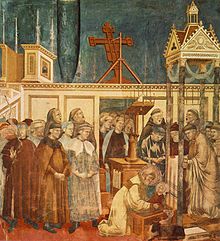
St. Francis at Greccio by Giotto
The primeval nascence scene has been institute in the early on Christian crypt of Saint Valentine.[5] It traces to A.D. 380.[6]
Saint Francis of Assisi, who is now commemorated on the calendars of the Catholic, Lutheran and Anglican liturgical calendars, is credited with creating the beginning live nascency scene[7] [8] [ix] [10] in 1223 at Greccio, primal Italy,[8] [eleven] in an attempt to place the accent of Christmas upon the worship of Christ rather than upon "textile things".[12] [13] The birth scene created past Saint Francis,[7] is described by Saint Bonaventure in his Life of Saint Francis of Assisi written around 1260.[14] Staged in a cave near Greccio, Saint Francis' nativity scene was a living ane[8] with humans and animals bandage in the Biblical roles.[15] Pope Honorius III gave his blessing to the exhibit.[16]
Such reenactment exhibitions became hugely popular and spread throughout Christendom.[fifteen] Within a hundred years every Catholic church building in Italy was expected to have a nativity scene at Christmastime.[11] Eventually, statues replaced human and animal participants, and static scenes grew to elaborate affairs with richly robed figurines placed in intricate mural settings.[xv] Charles III, King of the Two Sicilies, collected such elaborate scenes, and his enthusiasm encouraged others to do the same.[11]
The scene's popularity inspired much imitation throughout Christian countries, and in the early modern period sculpted cribs, oft exported from Italian republic, were set up upward in many Christian churches and homes.[17] These elaborate scenes reached their artistic apogee in the Papal State, in Emilia, in the Kingdom of Naples and in Genoa. By the cease of the 19th century nascency scenes became widely popular in many Christian denominations, and many versions in various sizes and made of diverse materials, such as terracotta, paper, wood, wax, and ivory, were marketed, ofttimes with a properties setting of a stable.[1]
Different traditions of nativity scenes emerged in different countries. Hand-painted santons are popular in Provence. In southern Germany, Austria and Trentino-Alto Adige, the wooden figurines are handcut. Colorful szopki are typical in Poland.
A tradition in England involved baking a mince pie in the shape of a manger which would hold the Christ kid until dinnertime, when the pie was eaten. When the Puritans banned Christmas celebrations in the 17th century, they also passed specific legislation to outlaw such pies, calling them "idolaterie in crust".[11]
Distinctive nativity scenes and traditions have been created around the earth and are displayed during the Christmas season in churches, homes, shopping malls, and other venues, and occasionally on public lands and in public buildings. The Vatican has displayed a scene in St. Peter's Square near its Christmas tree since 1982 and the Pope has for many years blessed the mangers of children assembled in St. Peter'southward Foursquare for a special ceremony.[18] [ citation needed ] In the Us, the Metropolitan Museum of Art in New York City annually displays a Neapolitan Baroque nativity scene before a xx feet (6.1 m) bluish spruce.[nineteen]
Nativity scenes have not escaped controversy. A life-sized scene in the United Kingdom featuring waxwork celebrities provoked outrage in 2004,[20] and, in Spain, a urban center council forbade the exhibition of a traditional toilet humor grapheme[21] in a public nativity scene. People for the Ethical Treatment of Animals (PETA) claimed in 2014 that animals in living displays lacked proper care and suffered corruption.[22] In the The states, nativity scenes on public lands and in public buildings have provoked court challenges, and the prankish theft of ceramic or plastic nativity figurines from outdoor displays has become commonplace.[23]
Components [edit]
Static nativity scenes [edit]
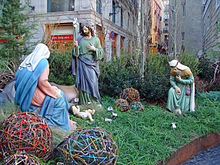
Outdoor nascency scene of life-sized figurines in Barcelona (2009)
Static nativity scenes may exist erected indoors or outdoors during the Christmas season, and are composed of figurines depicting the infant Jesus resting in a manger, Mary, and Joseph. Other figures in the scene may include angels, shepherds, and various animals. The figures may exist made of whatsoever fabric,[8] and arranged in a stable or grotto. The Magi may also announced, and are sometimes not placed in the scene until the week post-obit Christmas to account for their travel fourth dimension to Bethlehem.[24] While nearly home nativity scenes are packed away at Christmas or soon thereafter, nascence scenes in churches usually remain on display until the feast of the Baptism of the Lord.[8]
The nascence scene may not accurately reflect gospel events. With no basis in the gospels, for example, the shepherds, the Magi, and the ox and donkey may exist displayed together at the manger. The art form can be traced dorsum to eighteenth-century Naples, Italy. Neapolitan nativity scenes do not represent Palestine at the time of Jesus just the life of the Naples of 1700, during the Bourbon period. Families competed with each other to produce the most elegant and elaborate scenes and so, side by side to the Child Jesus, to the Holy Family and the shepherds, were placed ladies and gentlemen of the nobility, representatives of the bourgeoisie of the fourth dimension, vendors with their banks and miniatures of cheese, breadstuff, sheep, pigs, ducks or geese, and typical figures of the time like gypsy predicting the future, people playing cards, housewives doing shopping, dogs, cats and chickens.[25]

Peruvian crucifix with nascency scene at its base of operations, c.1960
Regional variants on the standard nascence scene are many. The putz of Pennsylvania Dutch Americans evolved into elaborate decorative Christmas villages in the twentieth century. In Colombia, the pesebre may feature a town and its surrounding countryside with shepherds and animals. Mary and Joseph are frequently depicted as rural Boyacá people with Mary clad in a countrywoman'south shawl and fedora hat, and Joseph garbed in a poncho. The baby Jesus is depicted as European with Italianate features. Visitors bringing gifts to the Christ kid are depicted every bit Colombian natives.[26] After World State of war I, big, lighted manger scenes in churches and public buildings grew in popularity, and, past the 1950s, many companies were selling backyard ornaments of non-fading, long-lasting, weather resistant materials telling the nativity story.[27]
Living nativity scenes [edit]

Living birth in Sicily, which also contains a mock rural 19th-century hamlet
Exhibitions similar to the scene staged past St. Francis at Greccio became an almanac event throughout Christendom.[10] Abuses and exaggerations in the presentation of mystery plays during the Eye Ages, however, forced the church to prohibit performances during the 15th century.[viii] The plays survived exterior church building walls, and 300 years after the prohibition, German language immigrants brought uncomplicated forms of the nascency play to America. Some features of the dramas became part of both Catholic and Protestant Christmas services with children often taking the parts of characters in the nativity story. Nascency plays and pageants, culminating in living nativity scenes, eventually entered public schools. Such exhibitions have been challenged on the grounds of separation of church and state.[8]

Living nascence in Bascara
In some countries, the nativity scene took to the streets with human performers costumed as Joseph and Mary traveling from house to business firm seeking shelter and existence told by the houses' occupants to move on. The couple'due south journey culminated in an outdoor tableau vivant at a designated identify with the shepherds and the Magi then traveling the streets in parade fashion looking for the Christ child.[27]
Living nativity scenes are non without their problems. In the U.s. in 2008, for example, vandals destroyed all 8 scenes and backdrops at a drive-through living nascency scene in Georgia. About 120 of the church'south 500 members were involved in the construction of the scenes or playing roles in the product. The impairment was estimated at more US$2,000.[28]
In southern Italy, living nativity scenes (presepe vivente) are extremely popular. They may be elaborate affairs, featuring non only the archetype birth scene but also a mock rural 19th-century village, complete with artisans in traditional costumes working at their trades. These attract many visitors and take been televised on RAI. In 2010, the erstwhile city of Matera in Basilicata hosted the world'due south largest living nativity scene of the time, which was performed in the historic center, Sassi.[29]
Animals in nativity scenes [edit]

The ox, the ass, and the infant Jesus in one of the earliest depictions of the nativity, (Ancient Roman Christian sarcophagus, fourth century)
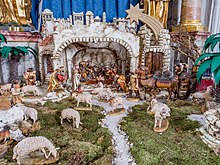
Christmas crib parish Church St. James in Ebing, Frg
A donkey (or ass) and an ox typically appear in nativity scenes. Besides the necessity of animals for a manger, this is an allusion to the Volume of Isaiah: "the ox knoweth his possessor, and the ass his master's crib; just Israel doth not know, my people doth not consider" (Isaiah i:iii). The Gospels practice not mention an ox and donkey[xxx] Some other source for the tradition may be the extracanonical text, the Gospel of Pseudo-Matthew of the seventh century. (The translation in this text of Habakkuk 3:2 is not taken from the Septuagint.):[31] [32]
"And on the third day after the nascence of our Lord Jesus Christ, Mary went out of the cave, and, entering a stable, placed the child in a manger, and an ox and an donkey adored him. And then was fulfilled that which was said by the prophet Isaiah, "The ox knows his owner, and the donkey his master'south crib." Therefore, the animals, the ox and the ass, with him in their midst incessantly adored him. Then was fulfilled that which was said by Habakkuk the prophet, saying, "Between ii animals you are made manifest."[30]
The ox traditionally represents patience, the nation of State of israel, and Old Attestation sacrificial worship while the ass represents humility, readiness to serve, and the Gentiles.[33]
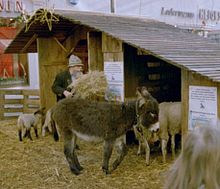
The ox and the ass, likewise as other animals, became a part of birth scene tradition. In a 1415, Corpus Christi celebration, the Ordo paginarum notes that Jesus was lying between an ox and an donkey.[34] Other animals introduced to nativity scenes include elephants and camels.[24]
Past the 1970s, churches and community organizations increasingly included animals in nascency pageants.[27] Since then, car-accessible "drive-through" scenes with sheep and donkeys have become popular.[35]
Traditions [edit]
Commonwealth of australia [edit]

Nativity Scene at St. Elizabeth's, Dandenong North. Creator and Artist Wilson Fernandez
Christmas is celebrated by Australians in a number of ways. In Australia, it's summer season and is very hot during Christmas time.
During the Christmas fourth dimension, locals and visitors visit places around their towns and suburbs to view the outdoor and indoor displays. All over the towns, the places are lit with colorful and modern spectacular lighting displays. The displays of nativity scenes with Aussie featured native animals like kangaroos and koalas are also evident.[ citation needed ]
In Melbourne, a traditional and authentic Birth Scene is on brandish at St. Elizabeth's Parish, Dandenong North. This almanac Australian Nativity Scene creator and artist Wilson Fernandez has been building and creating the traditional nativity scenes since 2004 at St. Elizabeth'south Parish.[36]
To marker this special event, Most Reverend Denis Hart Archbishop of Melbourne celebrated the Vigil Mass and blest the Nativity Scene on Saturday, 14 December 2013.[37]
Canada [edit]
Bethlehem Live is an all-volunteer living nativity produced by Gateway Christian Community Church in Winnipeg, Manitoba, Canada. The production includes a reconstruction of the ancient boondocks of Bethlehem and vii individual vignettes. There as well happens to exist an annual, highly publicized birth scene at the St. Patrick's Basilica, Ottawa in Ottawa, Ontario.[38] [39]
Czech Republic [edit]

Function of the Krýza's crèche – a castle
The Czech Commonwealth, and the cultures represented in its predecessors i.e. Czechoslovakia and the lands of former Bohemia, take a long tradition regarding betlémy (literally "Bethlehems"), crèches. The tradition of home Nativity scenes is often traced to the 1782 ban of church and institutional crèches past emperor Joseph II, officially responding to public disturbances and the resulting "loss of dignity" of such displays.[xl] [41] As this followed the Edict of Toleration proclaimed the previous year, it reduced State support of the Catholic church in this multi-confessional land.[42] [43]
Třebechovice pod Orebem [edit]
The Museum of Nativity Scenes in Třebechovice pod Orebem has over 400 examples dated from the 18th until early 20th century. The most remarkable is the Probošt's mechanical Christmas crib, then called Třebechovice'due south Bethlehem.
The upshot of cost arose, and paper-cut crèches, "the crèche of the poor", became one major expression,[44] too as forest-carved ones, some of them spectacular as they grew in complexity and detail. Many among the major Czech artists, sculptors and illustrators have as a significant part of their legacy the crèches that they created.
The following people are known for creating Czech paper crèches:
- Mikoláš Aleš (1852–1913), painter famed for his murals of the National Theatre
- Josef Wenig (1885–1939), illustrator, theatre decorator and playwright
- Josef Lada (1887–1957), known for his work in The Practiced Soldier Švejk
- Marie Fischerová-Kvěchová (1892–1984), illustrator of a large number of children books
Krýza's crèche [edit]
Tomáš Krýza (1838–1918) congenital in a period of over lx years a nativity scene roofing 60 m2 (length 17 m, size and height ii m) which contains 1,398 figures of humans and animals, of which 133 are moveable. It is on display in southern Maverick boondocks Jindřichův Hradec. It figures as the largest mechanical birth scene in the world in the Guinness Volume of World Records.[45]
Gingerbread crèches [edit]
Gingerbread Nativity scenes and cribs in the church of St. Matthew in Šárka (Prague 6 Dejvice) accept around 200 figures and houses, the tradition dates from since 1972; every yr new ones are baked and subsequently holidays eaten.[ citation needed ]
France (Santons) [edit]
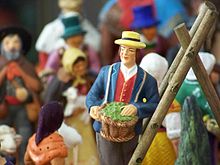
A santon (Provençal: "little saint") is a small hand-painted, terracotta nativity scene figurine produced in the Provence region of southeastern French republic.[46] In a traditional Provençal crèche, the santons correspond various characters from Provençal village life such as the pair of scissors grinder, the fishwife, and the chestnut seller.[46] The figurines were commencement created during the French Revolution when churches were forcibly closed and large birth scenes prohibited.[47] Today, their production is a family affair passed from parents to children.[48] During the Christmas flavor, santon makers gather in Marseille and other locales in southeastern French republic to display and sell their wares.[47]
Italy and the Vatican [edit]
In 1982, Pope John Paul Ii inaugurated the annual tradition of placing a nascency scene on display in the Vatican City in the Piazza San Pietro earlier the Christmas Tree.[49]
In 2006, the nativity scene featured seventeen new figures of spruce on loan to the Vatican from sculptors and wood sawyers of the town of Tesero, Italy in the Italian Alps.[50] The figures included peasants, a flutist, a bagpipe thespian and a shepherd named Titaoca.[50] Twelve nativity scenes created earlier 1800 from Tesero were put on display in the Vatican audience hall.[50]
The Vatican nativity scene for 2007 placed the nascence of Jesus in Joseph'southward house, based upon an estimation of the Gospel of Matthew. Mary was shown with the newborn baby Jesus in a room in Joseph's house. To the left of the room was Joseph'south workshop while to the correct was a busy inn—a comment on materialism versus spirituality.[51] The Vatican's written clarification of the diorama said, "The scene for this yr'southward Nascence recalls the painting fashion of the Flemish School of the 1500s."[52] The scene was unveiled on December 24 and remained in place until February two, 2008, for The Banquet of the Presentation of the Lord.[53] X new figures were exhibited with 7 on loan from the town of Tesero and three—a baker, a woman, and a child—donated to the Vatican.[53] The determination for the singular setting was believed to be part of a crackdown on fanciful scenes erected in various cities effectually Italy. In Naples, Italy, for instance, Elvis Presley and Prime Government minister of Italy Silvio Berlusconi, were depicted amongst the shepherds and angels worshipping at the manger.
In 2008, the Province of Trento, Italia, provided sculpted wooden figures and animals besides as utensils to create depictions of daily life.[54] The scene featured seventeen figures[54] with nine depicting the Holy Family, the Magi, and the shepherds.[55] The 9 figures were originally donated by Saint Vincent Pallotti for the birth at Rome'due south Church of Sant'Andrea della Valle in 1842[54] and eventually found their manner to the Vatican. They are dressed anew each year for the scene.[55] The 2008 scene was ready in Bethlehem with a fountain and a hearth representing regeneration and light.[56] The same year, the Paul VI Audience Hall exhibited a nascence designed past Mexican artists.[54]
Since 1968, the Pope has officiated at a special ceremony in St. Peter's Square on Gaudete Sunday that involves approval hundreds of mangers and Babies Jesus for the children of Rome.[sixteen] In 1978, 50,000 schoolchildren attended the anniversary.[sixteen]
Philippines (Belén) [edit]

In the bulk-Catholic Philippines, miniature, full-scale, or behemothic dioramas or tableaus of the nativity scene are known equally Belén (from the Spanish name for Bethlehem). They were introduced by the Castilian since the 16th century. They are an ubiquitous and iconic Christmas symbol in the Philippines, on par with the parol (Christmas lanterns depicting the Star of Bethlehem) which are often incorporated into the scene equally the source of illumination. Both the Belén and the parol were the traditional Christmas decorations in Filipino homes before Americans introduced the Christmas tree.[57] [58] [59] [60] [61] Most churches in the Philippines too transform their altars into a Belén at Christmas. They are also plant in schools (which too hold nativity plays), government buildings, commercial establishments, and in public spaces.[62] [63] [64]
The urban center of Tarlac holds an annual contest of giant Belén in a festival known as "Belenismo sa Tarlac".[65] [66] [67]
Poland [edit]


Szopka are traditional Polish nativity scenes dating to 19th century Kraków, Poland.[68] Its cultural significance has landed it on the UNESCO cultural heritage list. Their mod construction incorporates elements of Kraków'south historic architecture including Gothic spires, Renaissance facades, and Bizarre domes,[68] and utilizes everyday materials such every bit colored tinfoils, cardboard, and wood.[69] Some are mechanized.[seventy] Prizes are awarded for the most elaborately designed and decorated pieces[68] in an annual contest held in Kraków'southward chief square beside the statue of Adam Mickiewicz.[70] Some of the best are then displayed in Kraków'due south Museum of History.[71] Szopka were traditionally carried from door-to-door in the nativity plays (Jasełka) by performing groups.[72]
A similar tradition, called "betlehemezés" and involving schoolchildren conveying portable folk-art nativity scenes door-to-door, chanting traditional texts, is office of Hungarian folk culture, and has enjoyed a renaissance in recent years. An case of such a portable wooden nascency scene is on display at the Nativity Museum in Bethlehem.
United States [edit]

White House nascency scene, 2008
Perchance the best known nativity scene in America is the Neapolitan Baroque Crèche displayed annually in the Medieval Sculpture Hall of the Metropolitan Museum of Fine art in New York City. Its properties is a 1763 choir screen from the Cathedral of Valladolid and a twenty-foot blue bandbox decorated with a host of 18th-century angels. The birth figures are placed at the tree's base. The crèche was the gift of Loretta Hines Howard in 1964, and the choir screen was the gift of The William Randolph Hearst Foundation in 1956.[73] Both this presepio and the one displayed in Pittsburgh originated from the collection of Eugenio Catello.
A life-size nativity scene has been displayed annually at Temple Foursquare in Salt Lake City, Utah for several decades equally part of the large outdoor Christmas displays sponsored by The Church building of Jesus Christ of Latter-day Saints.
Each holiday season, from Low-cal Upward Night in November through Epiphany in January, the Pittsburgh Crèche is on display in downtown Pittsburgh, Pennsylvania. The Pittsburgh Creche is the world'southward merely authorized replica of the Vatican's Christmas crèche, on display in St. Peter's Square in Rome.[74] Pittsburgh's Carnegie Museum of Fine art besides displays a Neapolitan presepio. The presepio was handcrafted between 1700 and 1830, and re-creates the Nativity within a panorama of 18th-century Italian village life. More than than 100 homo and angelic figures, along with animals, accessories, and architectural elements, cover 250 foursquare anxiety and create a depiction of the Nascence as seen through the eyes of Neapolitan artisans and collectors.[75]
The Radio City Christmas Spectacular, an annual musical holiday stage prove presented at Radio City Music Hall in New York City, features a Living Nascency segment with live animals.[76] [77]
In 2005, President of the U.s.a., George W. Bush and his married woman, First Lady of the The states, Laura Bush displayed an 18th-century Italian presepio. The presepio was donated to the White House in the terminal decades of the 20th century.[78]
The Metropolitan Museum of Art in New York Urban center and the Carnegie Museum of Art in Pittsburgh annually display Neapolitan Bizarre nativity scenes which both originated from the collection of Eugenio Catello.
On her Christmas Twenty-four hour period 2007 idiot box bear witness, Martha Stewart exhibited the nativity scene she made in pottery classes at the Alderson Federal Prison Camp in Alderson, Due west Virginia while serving a 2005 sentence. She remarked, "Even though every inmate was only allowed to do ane a month, and I was only there for five months, I begged because I said I was an practiced potter—ceramicist actually—and could I delight make the unabridged nativity scene."[79] She supplemented her nativity figurines on the evidence with tiny artificial palm trees imported from Deutschland.[79]
Associations and notable collections [edit]
The Universalis Foederatio Praesepistica, World association of Friends of Cribs was founded in 1952, counting today xx national associations dedicated to this subject. The Central office is in Republic of austria.[eighty]
In the United States and Canada Friends of the Creche has over 200 members, with a major conference every two years.[81] FotC maintains a listing of permanent exhibits of Nativity scenes in the United States and a listing of permanent exhibits of Birth scenes in other parts of the world.
The Bavarian National Museum displays a notable collection of Nativity scenes from the fifteenth through nineteenth centuries.
Every twelvemonth in Lanciano, Abruzzo (Italy), a Nativity Scene exhibition (chosen in Italian "Riscopriamo il presepe") takes place at Auditorium Diocleziano, usually until the 6th of January. An average of 1 hundred Nativity scenes are shown, coming from every region of Italy. There are as well many Nascency scenes made by local kindergarten, primary, secondary and high school. The event is organised by Associazione Amici di Lancianovecchia[82]
Museums dedicated specifically to paper Birth scenes exist in Pečky (Czech republic).[83]
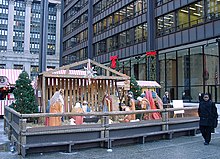
A static outdoor nascency scene in the Us, (Christkindlmarket, Chicago, Illinois)
Controversies [edit]
United States [edit]
Birth scenes have been involved in controversies and lawsuits surrounding the principle of accommodationism.[84]
In 1969, the American Civil Liberties Spousal relationship (representing three clergymen, an atheist, and a leader of the American Ethical Gild), tried to cake the construction of a nativity scene on The Ellipse in Washington, D.C.[85] When the ACLU claimed the authorities sponsorship of a distinctly Christian symbol violated separation of church building and land,[85] the sponsors of the fifty-year-former Christmas celebration, Pageant of Peace, who had an exclusive allow from the Interior Department for all events on the Ellipse, responded that the nativity scene was a reminder of America'south spiritual heritage.[85] The United States Courtroom of Appeals ruled on December 12, 1969, that the crèche exist allowed that yr.[85] The case continued until September 26, 1973, when the court ruled in favor of the plaintiffs[85] and found the involvement of the Interior Section and the National Park Service in the Pageant of Peace amounted to government support for organized religion.[85] The court opined that the nascency scene should exist dropped from the pageant or the regime end its participation in the effect in guild to avert "excessive entanglements" between government and faith.[85] In 1973, the nativity scene was not displayed.[85]

A Nascency scene inside an American habitation.

Nativity scenes are permitted on public lands in the United States as long as equal time is given to non-religious symbols.
In 1985, the United states Supreme Court ruled in ACLU v. Scarsdale, New York that birth scenes on public lands violate separation of church building and country statutes unless they comply with "The Reindeer Rule"—a regulation calling for equal opportunity for non-religious symbols, such as reindeer.[86] This principle was further antiseptic in 1989, when the Supreme Court in Canton of Allegheny v. ACLU ruled that a crèche placed on the m staircase of the Allegheny County Courthouse in Pittsburgh, PA violated the Establishment Clause, because the "primary or primary effect" of the brandish was to advance religion.
In 1994, at Christmas, the Park Lath of San Jose, California, removed a statue of the infant Jesus from Plaza de Cesar Chavez Park and replaced information technology with a statue of the plumed Aztec god, Quetzalcoatl, commissioned with United states$500,000 of public funds. In response, protestors staged a living birth scene in the park.[86]
In 2006, a lawsuit past the Alliance Defense Fund, a Christian legal organization in the United States, was brought against the state of Washington when it permitted a public display of a holiday tree and a menorah just not a nativity scene. Because of the lawsuit, the decision was fabricated to allow a birth scene to be displayed in the rotunda of the state Capitol, in Olympia, as long as other symbols of the season were included.[87]
In 2013, Gov. Rick Perry signed into Texas law the Merry Christmas bill which would allow school districts in Texas to brandish nativity scenes.
Baby Jesus theft [edit]
In the Usa, nativity figurines are sometimes stolen from outdoor public and individual displays during the Christmas season[88] in an human activity that is generally called Infant Jesus theft. The thefts are usually pranks with figurines recovered inside a few hours or days of their disappearances.[89] Some have been damaged beyond repair or defaced with profanity, antisemitic epithets, or Satanic symbols.[90] [91] It is unclear if Baby Jesus theft is on the rise as Usa federal law enforcement officials do not track such theft.[89] Some communities protect outdoor nascence scenes with surveillance cameras or GPS devices concealed within the figurines.[90]
United kingdom of great britain and northern ireland [edit]
In Dec 2004, Madame Tussaud'southward London, England, United Kingdom nativity scene featured waxwork models of soccer star David Beckham and his wife Victoria Beckham as Joseph and Mary, and Kylie Minogue every bit the Angel.[92] Tony Blair, George W. Bush, and the Duke of Edinburgh were bandage as the Magi while actors Hugh Grant, Samuel L. Jackson, and comedian Graham Norton were cast equally shepherds.[93] The celebrities were called for the roles by 300 people who visited the Madame Tussaud's in October 2004 and voted on the display. The Archbishop of Canterbury (Rowan Williams) was not impressed, and a Vatican spokesperson said the brandish was in very poor taste. Other officials reacted angrily, with one noting it was "a nascency stunt too far".[93] "We're pitiful if we have offended people," said Diane Moon, a spokesperson for the museum. She said the brandish was intended in the spirit of fun.[94] The scene was damaged in protest past James Anstice, a member of the Jesus Fellowship Church building, who pushed over one of the figures and knocked the caput off another. He was afterward ordered to pay £100 in bounty.[95]
Espana [edit]
There is a regional tradition in the Catalonia region where an additional figure is added to the Nativity scene: the Caganer . It depicts a person defecating. In 2005, the Barcelona metropolis council provoked a public outcry by commissioning a nativity scene which did non include a Caganer .[96]
Electronic Nativity scene of Begonte
Since 1972 an electronic Nascency scene in Begonte (Lugo, Spain), is visited by around 40,000 Galicians every twelvemonth. The scene represents the day and dark, the rain and snow, the culture and the works of the countryside way of life that has kept changing in contempo decades. The scene reproduces the houses of the region and the almost unknown environment of the rural Galicia from mid twentieth century.
A particular feature of the Nascence scene of Begonte is that its figures are animated electronically. Electronics in 1972 was a utopia. Because that today it is part of our daily lives, the Nativity scene of Begonte has impressed visitors by the move of its figures. It has also touched many for many years for its innocence, for reflecting tradition and history, for making the elderly settle like children, and the children feeling at home.
Information technology was declared of Galician tourist involvement in 2014. Year after year for the terminal fifty years, the Nativity scene of Begonte opens its physical doors from the first Saturday of Dec to the final Saturday of January. It is also possible to spotter it well-nigh at whatsoever time of the year, in Castilian, Galician and English, on the website world wide web.belendebegonte.es/belenvirtual.
Gallery [edit]
-

Christmas crib on the Saint Peter's square, Vatican
-

Living nativity at St. Wojciech Church building, Wyszków, Poland, 2006
-
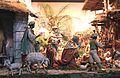
Christmas crib within the Saint Peter's Basilica, Vatican
-

Nativity scene in Buchach, Ukraine
-

Nascence scene in Buenos Aires (1924)
-
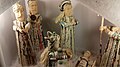
Christmas Crib
-

Crib family unit with shepherds at the crib exhibition in Bamberg 2015
-

Abstruse Birth display in a home.
-

Christmas Crib outside a Catholic church Goa, India
-

Christmas Crib & Tree display in Firm Mumbai, Republic of india.
See as well [edit]
- Weihnachtsberg - a traditional Christmas mountain scene that combines the nativity scene with mining motifs
References [edit]
- ^ a b "Introduction to Christmas Season". General Board of Discipleship (GBOD). The United Methodist Church. 2013. Archived from the original on 6 January 2015. Retrieved five January 2015.
Christmas is a flavor of praise and thanksgiving for the incarnation of God in Jesus Christ, which begins with Christmas Eve (Dec 24 afterwards sundown) or Day and continues through the Day of Epiphany. The name Christmas comes from the season'due south first service, the Christ Mass. Epiphany comes from the Greek word epiphania, which means "manifestation." New year's Eve or Day is oft celebrated in the United Methodist tradition with a Covenant Renewal Service. In addition to acts and services of worship for the Christmas Season on the following pages, encounter The Great Thanksgivings and the scripture readings for the Christmas Season in the lectionary.... Signs of the season include a Chrismon tree, a nativity scene (include the magi on the Day of Epiphany), a Christmas star, angels, poinsettias, and roses.
- ^ Berliner, R. The Origins of the Creche. Gazette des Beaux-Arts, xxx (1946), p. 251.
- ^ Dark-brown, Raymond E.. The Nativity of the Messiah. Doubleday, 1997.
- ^ Vermes, Geza. The Nativity: History and Legend. Penguin, 2006
- ^ Osborne, John (31 May 2020). Rome in the Eighth Century: A History in Art. Cambridge University Printing. p. 31. ISBN978-1-108-87372-7.
- ^ Tuleja, Thaddeus F. (1999). Curious Community: The Stories Behind More 300 Popular American Rituals. Bulletin board system Publishing Corporation. ISBN978-one-57866-070-4.
Francis Weiser (1952) says that the beginning known depiction of the nativity scene, found in the catacombs of Rome , dates from A.D. 380.
- ^ a b Matheson, Lister M. (2012). Icons of the Eye Ages: Rulers, Writers, Rebels, and Saints. ABC-CLIO. p. 324. ISBN978-0-313-34080-two.
He was responsible for staging the first living Nativity scene or creche, in Christian history; and he was too Christianity'south offset stigmatic. He shares the honor of being patron saint of Italy with Saint Catherine of Siena. His feast day is celbrated on October 4, the day of his death; many churches, including the Anglican, Lutheran, and Episcopal churches, commemorate this with the blessing of the animals.
- ^ a b c d e f chiliad Dues, Greg.Catholic Customs and Traditions: A Popular Guide Twenty-Third Publications, 2000.
- ^ Thomas, George F.. Vitality of the Christian Tradition. Ayer Co. Publishing, 1944.
- ^ a b "#MyLivingNativity". Upper Room Books. Archived from the original on 2021-11-07. Retrieved 2018-10-31 .
- ^ a b c d Johnson, Kevin Orlin. Why Do Catholics Practise That? Random Business firm, Inc., 1994.
- ^ Mazar, Peter and Evelyn Grala. To Crown the Year: Decorating the Church Through the Year. Liturgy Training, 1995. ISBN i-56854-041-eight
- ^ Federer, William J.. There Really is a Santa Claus: The History of Saint Nicholas & Christmas Holiday Traditions. Amerisearch, Inc., 2003. p. 37.
- ^ St. Bonaventure. "The Life of St. Francis of Assisi". e-Catholic 2000. Archived from the original on fourteen June 2014. Retrieved 28 September 2013.
- ^ a b c Santino, Jack. All Around the Year: Holidays and Celebrations in American Life. University of Illinois Press, 1995. ISBN 0-252-06516-6.
- ^ a b c Christmas in Italy. World Book Encyclopedia, Inc., 1996, 1979.
- ^ Orsini, Joseph E. (2000). Italian Family Cooking. Macmillan. ISBN978-0-312-24225-1.
In later centuries the Nascence scenes became beautiful works of art in wooden sculptures and ceramic figures. The most remarkable ones were created in southern Italy, peculiarly in Naples, Calabria, and Sicily, Today, in well-nigh Christian homes the Presepio, Creche, or Nativity Scene is in a special place of award reserved for it below the Christmas tree. In both Italian republic and in Italian parishes...the Nativity Scenes is placed, significantly, right in forepart of the main altar of the church building, and Christmas copse adorn the spaces behind or on the side of the altar.
- ^ "Pope blesses Birth scene statues, calls them signs of God's love". TheCatholicSpirit.com. 2019-12-17. Archived from the original on 2019-12-24. Retrieved 2020-01-06 .
- ^ "Archived re-create". Archived from the original on 2016-12-21. Retrieved 2016-12-21 .
{{cite spider web}}: CS1 maint: archived copy as title (link) - ^ "Celebrity wax Nativity scene vandalized". Chicago Tribune. Archived from the original on 28 December 2014. Retrieved 26 December 2014.
- ^ "BBC News - A traditional Nativity scene, Catalan-manner". BBC News. 23 December 2010. Archived from the original on 24 December 2010. Retrieved 26 Dec 2014.
- ^ "PETA mistakenly targets nativity scene - US news - Weird news - Creature weirdness - NBC News". msnbc.com. Archived from the original on 26 December 2014. Retrieved 26 Dec 2014.
- ^ [1] [ permanent dead link ]
- ^ a b Tangerman, Elmer John. The Large Book of Whittling and Woodcarving. Courier Dover Publications, 1989. ISBN 0-486-26171-nine.
- ^ "Neapolitan Crib: The crib and 1700s Naples." Archived 2013-12-20 at Wikiwix. CitiesItaly.com. Retrieved December 18, 2013.
- ^ Duncan, Ronald J. The Ceramics of Ráquira, Colombia: Gender, Work, and Economical Modify. University Press of Florida, 1998. ISBN 0-8130-1615-0.
- ^ a b c Collins, Ace. Stories Backside the Smashing Traditions of Christmas. Zondervan, 2003. ISBN 0-310-24880-9.
- ^ Mehta, Hemant. "Would You Help Restore a Nascency Scene?" Archived 2009-02-09 at the Wayback Machine. The Friendly Atheist, December xiii, 2008.
- ^ "Most people in a nascency scene: Welton Baptist Church building sets world record". worldrecordacademy.com. iv December 2011. Archived from the original on iv March 2016. Retrieved 6 January 2015.
- ^ a b Hobgood-Oster, Laura. Holy Dogs and Asses: Animals in the Christian Tradition. University of Illinois Press, 2008. ISBN 0-252-03213-6.
- ^ Gill, John (1748–63). John Gill's Exposition of the Bible. Archived from the original on 2010-08-21.
- ^ Saxon, Elizabeth (2006). The Eucharist in Romanesque French republic: iconography and theology. Boydell Press. p. 107. ISBN978-ane-84383-256-0. Archived from the original on 2021-11-07. Retrieved 2020-10-19 .
- ^ Webber, F.R.. Church building Symbolism. Kessinger Publishing, 2003. ISBN 0-7661-4009-1.
- ^ Rex, Pamela M.. The York Mystery Cycle and the Worship of the City. DS Brewer, 2006. ISBN i-84384-098-7.
- ^ "California Nativity: Drive Thru & Living Nativities in California" Archived 2009-01-27 at the Wayback Machine. BeachCalifornia.com. Retrieved January viii, 2008.
- ^ "Australian Nativity Scene Homepage". Australian Nativity Scene Homepage. Archived from the original on 2015-12-23. Retrieved 2015-12-22 .
- ^ "Kairos, Volume 25 Outcome 23". world wide web.cam.org.au. Archived from the original on 2016-03-04. Retrieved 2015-12-22 .
- ^ "Doing the time-warp". CBC News. 12 December 2010. Archived from the original on 4 March 2011.
- ^ "Business-Class Web Hosting past (mt) Media Temple". Archived from the original on four March 2016. Retrieved 26 December 2014.
- ^ "From Nutshells to Life‑size Statues" (PDF). Bridge Publishing House. Dec 2010. Archived (PDF) from the original on 2 December 2013. Retrieved 24 November 2013.
- ^ Velinger, January (December 7, 2005). "Czech Nascency scenes". Archived from the original on three December 2013. Retrieved 24 November 2013.
- ^ "Edict of Toleration (two January 1782): Emperor Joseph II" (PDF). New Hartford, New York: New Hartford Key School District. Archived (PDF) from the original on 3 December 2013. Retrieved 30 November 2013.
- ^ "The Eighteenth Century". LITURGIE &CETERA. Archived from the original on two December 2013. Retrieved 24 Nov 2013.
- ^ Osborne (2004). "Paper Crèches". Archived from the original on 2014-12-31. Retrieved 24 November 2013.
- ^ "Krýza Nativity Scene". Jindřichův Hradec Museum. Archived from the original on 2021-09-01. Retrieved 2021-09-27 .
- ^ a b Porter, Darwin, and Danforth Prince and Cheryl A. Pientka. France for Dummies. For Dummies, 2007. ISBN 0-470-08581-9.
- ^ a b Williams, Nicola. Lonely Planet: Provence and the Côte D'Azur. Lonely Planet, 2007. ISBN 1-74104-236-4.
- ^ "Christmas in France". Earth Book, Inc., 1995. ISBN 0-7166-0876-6.
- ^ Tater, Bruce and Alessandra de Rosa. Italy for Dummies. For Dummies, 2007. ISBN 0-470-06932-5.
- ^ a b c Wooden, Cindy. "No Room at the Inn? Vatican Nativity Scene Gets More Figures". Cosmic Online International News, December 18, 2007.
- ^ "Vatican Nativity Scene Trades Manger for St. Joseph's House". Cosmic News Agency.
- ^ Glatz, Carol. "Vatican Nativity Scene Places Christ's Birth in Building in Bethlehem". Catholic News Service, December 26, 2007.
- ^ a b Glatz, Carol. "Vatican Nativity Scene". Catholic Online, December 15, 2007.
- ^ a b c d Bunson, Matthew E.. Cosmic Annual 2009. Our Lord's day Visitor Publishing, 2008. ISBN ane-59276-441-X.
- ^ a b De Cristofaro, Maria, and Sebastian Rotella. "Vatican, Rome Become Head-to-Head with Nativities" Archived 2008-12-27 at the Wayback Machine. Los Angeles Times, December 24, 2008.
- ^ CNS, Vatican Nascency scene unveiled Archived 2009-05-xiv at Wikiwix, Dec 24, 2008.
- ^ Bondoc, Joshua (22 December 2021). "Christmas in our isles, a long enduring feast (Starting time published 1978, Television Times magazine)". PhilStar Global . Retrieved 24 December 2021.
- ^ Ferrolino, Mark Louis F. (fifteen December 2017). "A Christmas like no other". BusinessWorld . Retrieved 24 December 2021.
- ^ Macairan, Evelyn (19 December 2010). "'Belen virtually important Christmas decor'". PhilStar Global . Retrieved 24 December 2021.
- ^ Gonzalez, Joaquin Jay (2009). Filipino American Faith in Action: Immigration, Religion, and Civic Engagement. NYU Press. p. 18. ISBN9780814732977.
- ^ Laquian, Eleanor R. "Christmas Belen tradition brings Baby Jesus to Vancouver homes". CanadianFilipino.net . Retrieved 24 December 2021.
- ^ Dice, Elizabeth A. (2009). Christmas and Hanukkah. Infobase Publishing. p. 33. ISBN9781438119717.
- ^ Bowler, Gerry (2012). The Earth Encyclopedia of Christmas. McClelland & Stewart. ISBN9781551996073.
- ^ Llamas, Cora (20 Dec 2021). "The Philippines Has the Longest Christmas Flavour in the World". Christianity Today . Retrieved 24 Dec 2021.
- ^ Moaje, Marita (15 November 2021). "'Belenismo' continues tradition of bringing hope, inspiration". Philippine News Agency. Republic of the Philippines. Retrieved 24 Dec 2021.
- ^ Concepcion, Pocholo (xv November 2017). "Bringing back the 'belen'". Lifestyle.Inq. Philippine Daily Inquirer. Retrieved 24 December 2021.
- ^ Dayrit, Christine (16 Dec 2018). "Belenismo: A spectacle of hope". PhilStar Global . Retrieved 24 December 2021.
- ^ a b c Deck-Partyka, Alicja. Poland: A Unique State and Its People. AuthorHouse, 2006. ISBN one-4259-1838-7.
- ^ Salter, Mark, and Jonathan Bousfield. Poland. Penguin Putnam, 2002.
- ^ a b Wilson, Neil. Poland. Solitary Planet, 2005. ISBN 1-74059-522-Ten.
- ^ Johnstone, Sarah. Europe on a Shoestring. Lonely Planet, 2007. ISBN 1-74104-591-half-dozen.
- ^ Silverman, Deborah Anders. Polish-American Sociology. Academy of Illinois Printing, 2000. ISBN 0-252-02569-5
- ^ Special Exhibitions Archived 2009-12-04 at the Wayback Machine Metropolitan Museum of Art
- ^ Albrecht Powell. "Pittsurgh Creche - Pittsburgh Nativity Scene". About. Archived from the original on 26 December 2014. Retrieved 26 Dec 2014.
- ^ "Carnegie Museum of Art". Archived from the original on 14 May 2013. Retrieved 26 Dec 2014.
- ^ "Living birth scene in Radio City Christmas Spectacular". YouTube. Archived from the original on 2017-03-ten.
- ^ "Inflow of alive animals that appear in Radio City Christmas Spectacular'southward living nascence scene". YouTube. Archived from the original on 2017-03-09.
- ^ Walters, Gary. "Ask the White House" Archived 2017-07-12 at the Wayback Auto. 2005.
- ^ a b "Martha Congenital Nativity Scene in Prison house". Huffington Post, December 25, 2007.
- ^ "Universalis Foederatio Praesepistica". Archived from the original on 2013-12-02.
- ^ "Friends of the Creche". Archived from the original on 2 December 2013. Retrieved 23 November 2013.
- ^ "Riscopriamo il presepe 2014" (PDF). Archived from the original (PDF) on 2014-12-xix.
- ^ "Papírové betlémy". Papirove-betlemy.sweb.cz . Retrieved 8 Nov 2021.
- ^ Sherrill, Roland A.. Religion and the Life of the Nation. University of Illinois Press. 1990. p. 165.
- ^ a b c d e f m h Menendez, Albert J.. Christmas in the White Business firm. The Westminster Press, 1983.
- ^ a b Comfort, David. Only Say Noel: A History of Christmas from the Birth to the Nineties. Simon and Schuster, 1995. ISBN 0-684-80057-8.
- ^ "Nonbelievers' sign at Capitol counters Nativity" Archived 2012-01-22 at the Wayback Motorcar. Seattle Times. December ii, 2008.
- ^ Cloud, Olivia Yard. Joy to the Earth: Inspirational Christmas Letters from America's Preachers Archived 2016-06-03 at the Wayback Motorcar. Simon and Schuster, 2006. ISBN 1-4165-4000-8. Retrieved January 2, 2009.
- ^ a b Nasaw, Daniel."Thefts of Infant Jesus Figurines Sweep United states" Archived 2013-09-05 at the Wayback Machine. The Guardian. Jan 1, 2009. Retrieved January iii, 2009.
- ^ a b "Communities Protect Baby Jesus Statues With Hidden Cameras, GPS" Archived 2008-12-14 at the Wayback Machine. Associated Press. December 10, 2008. Retrieved Jan 2, 2009.
- ^ Lee, Don."Suspect Arrested in Infant Jesus Theft" Archived 2008-12-28 at the Wayback Machine Lovely County Citizen, Eureka Springs, Arkansas. December 22, 2008. Retrieved January 2, 2009.
- ^ "Madame Tussaud'south Celebrity Birth Scene" Archived 2011-05-26 at the Wayback Machine. Retrieved January v, 2009.
- ^ a b "Posh and Beckham in Wax Nascency" Archived 2006-03-30 at the Wayback Car. BBC News, Dec 8, 2004. Retrieved January 5, 2008.
- ^ "Celebrity Nativity Scene Draws Ire in UK" Archived 2008-12-02 at the Wayback Automobile. Ruddy Orbit, December 9, 2004.
- ^ "Becks waxworks vandal discharged- BBC News" Archived 2007-01-25 at the Wayback Machine Retr. 8/i/2017
- ^ "Els pessebres més polèmics de Sant Jaume". Betevé (in Catalan). 2018-11-26. Archived from the original on 2019-12-09. Retrieved 2019-12-09 .
External links [edit]
 Media related to Nativity scenes at Wikimedia Commons
- A selected English bibliography – 2013 of the Friends of the Creche. Also links to bibliographies in other languages
- The Mermaid in Mexican Folk Creches. An commodity portraying how pagan elements have become role of this Christian art course.
- links to national associations Universalis Foederatio Praesepistica The International Association of Friends of the Creche
- Discover the Christmas Cribs and Santons of Provence on Notreprovence.fr (English)
- The Living Nativity by Larry Peacock
Source: https://en.wikipedia.org/wiki/Nativity_scene
0 Response to "Natuvity Scene Without Baby Jesus Until Christmas Eve"
Publicar un comentario